


The battle for the Republic ... Sin has public consequences.

Michael V. Fox [1940-2025] - rabbi, Hebrew scholar, and professor emeritus at the University of Wisconsin–Madison - was among the leading modern authorities on Biblical wisdom literature. Trained in Biblical Studies, Semitics, and Egyptology at the Hebrew University of Jerusalem, Fox brought unusual precision to Proverbs, Ecclesiastes, the Book of Esther, and the Song of Songs.
His indispensable 2-volume Anchor Yale Bible Commentary on Proverbs, first brought to my attention by Dr. Bruce K. Waltke, remains one of the most significant modern treatments of Solomon’s wisdom.
Fox’s central insight from Proverbs is worth stating plainly: “Studying wisdom produces social virtues, the underpinnings of society.” It is not merely a collection of moral sayings but a curriculum for forming the virtues that uphold individuals, families, communities, and the social order itself.
That is precisely what America’s Founders understood of Scripture as they anchored early education in the Bible, as represented, among others, by Fisher Ames [1758-1808], the Massachusetts statesman, member of First Congress, and principal drafter of the House language that became the First Amendment.
As new schoolbooks began displacing Scripture in the classroom, Ames warned that moral instruction detached from the Bible would weaken the foundations of the Republic. Writing in The Palladium in January 1801, he asked: “Why then … should not the Bible regain the place it once held as a school book? Its morals are pure, its examples captivating and noble.”
Ames embraced what Solomon had taught long before him, and what early American classrooms once emphasized: education is not merely the transfer of information. It is the formation of moral character.
The Bible was not a prop, a decoration, or a coffee-table ornament in early American education. It was the principal text and moral architecture by which children learned truth, virtue, duty, restraint, reverence, and the fear of the Lord - the character required for a people to sustain ordered liberty.
This same insight animated last week’s column, quoting Marcello Pera - secular liberal philosopher and former president of the Italian Senate - who argued that Western freedom depends upon Christianity’s moral and cultural roots.
Though a self-described non-believer, Pera was not issuing an altar call in his must-read Why We Should Call Ourselves Christians: The Religious Roots of Free Societies. He was making a harder argument: that even from a purely secular philosophical standpoint, the West cannot long preserve its freedoms while severing itself from its Christian inheritance.
This is precisely our dispute with contemporary secular theories of education. If Biblical wisdom produces the social virtues that uphold a land, then removing it from education does not leave a neutral classroom. It leaves a vacuum, and vacuums are always filled.
Education is never neutral. The question is not whether a child’s character will be formed, but by whom, toward what end, and under whose authority.
Current secular theories have schooled America’s youth in independence, lingering ill-will towards the American Founders, and self-expression without moral boundaries. To use the phrasing of Proverbs 2:13-14, secularism has catechized a generation to “walk in the ways of darkness,” to enjoy evil, and to “delight in the perversity of the wicked.”
That is not education. It is a formation marked by ungodliness, immorality, corruption, and the victimhood attitude that everyone has wronged them.
Undisputedly, moral rebellion produces political instability. People who reject God’s unending order eventually forfeit social order. Sin has public consequences. When a people abandons righteousness, wisdom, restraint, and the fear of the Lord, what follows is not liberty but fragmentation. The Book of Proverbs is not merely personal advice. It is political theology.
It teaches that the stability of a nation rests not first on economics, elections, courts, or constitutions, but on the moral and spiritual condition of the people: “Righteousness exalts a nation, but sin is a reproach to any people,” as it rightly says in Proverbs 14:34. The glory of a nation lies in its righteousness, not in its Gross National Product or military prowess.
Somebody will disciple the next generation. Somebody will define truth. Somebody will teach children what is good and evil, noble and shameful, lawful and unlawful, beautiful and profane.
The only question is whether that formation will be rooted in ‘The fear of the Lord’, or in a rival secular creed that teaches conduct contrary to a Biblical standard of right and wrong. The ethical path alone, although narrow, is the safe one.
America’s Founders understood that liberty requires virtue, and virtue requires moral formation. George Washington called religion and morality the indispensable supports of political prosperity. John Adams warned that our Constitution was made only for a moral and religious people.
James Madison argued in Federalist No. 48 that written constitutional limits alone, calling them mere “parchment barriers,” are insufficient to restrain power when the people and their institutions lack the virtue to enforce them.
Plato, student of Socrates and teacher of Aristotle, framed the civilizational question that every free people must answer: Who teaches the children, and what do we teach them?
The answer to those two questions will determine whether this nation flourishes or flounders over the next 30 years.
America will continue to fracture and fall apart, unless Biblical Christians recover responsibility for education - in home, church, Christian schools, classical academies, homeschooling, and, where possible, public schools.
The battle for the Republic is in large measure a battle over who forms the children.
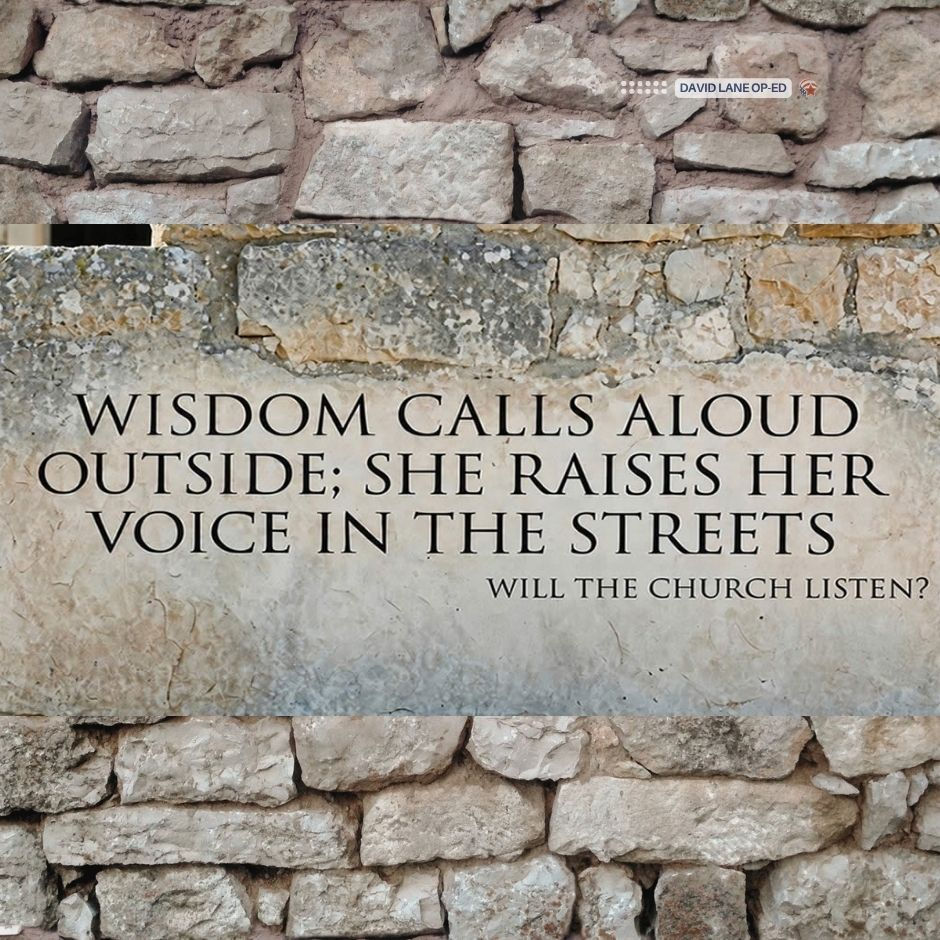
Thankfully, after a long absence, Gideons and Rahabs are entering the public arena. Men and women who understand the times are stepping forward, not merely to win elections, but to restore wisdom, righteousness, and the fear of the Lord to the gates of the city.
My pastor in California ran for the State Assembly in 2014. In the process, he hosted 150 coffees in the homes of people who would never darken the doors of a church.
That is what happens when the ekklesia leaves the building and enters the public square. The children are watching. The nation is waiting.
Godspeed.
David Lane
American Renewal Project


Comments