


If the Church will not disciple the nation’s children ... the state will.

Erin Friday, a licensed California attorney and lifelong Democrat, was recently interviewed by Jan Jekielek, host of American Thought Leaders.1 Ms. Friday alleges that her 13-year-old daughter was socially transitioned at school without parental consent, which in ‘transphysics’ translates as a girl starting to live publicly as a boy through a new name, pronouns, and social recognition.
After Ms. Friday objected to the school administrators and her daughter’s teacher, Child Protective Services and the police appeared at her doorstep. She further claims that parents in parts of California face similar coercive pressure to affirm a child’s gender identity under threat of state intervention; meaning that the government may investigate the family and, if authorities determine a child is being harmed, remove the child from the home.
Is this still America where such moral turpitude is happening?
Elon Musk responded publicly, writing, “Those who pushed this evil will pay dearly.”2 |
Although public education and curriculum in California will surely be leading the nation in the institution of sexualized content to minors, the problem is not confined to a single state; it is spreading nationwide. Take for instance licentious Indiana, where 13- and 14-year-old girls are reportedly taught that “oral sex, anal sex, sexual fantasy, masturbation, touching each other's genitals, and vaginal intercourse are all equal to saying, ‘I like you.’” |
Contemporary American Christendom’s influence on culture now appears nearly irrelevant and inconsequential. For decades, the Church has mistaken silence for civility and cultural retreat for righteousness. For example, Pamela Brown [born 1983], a prominent anchor and chief investigative correspondent for CNN, took it upon herself to examine “the growing influence of Christian Nationalism, an ideology rooted in the belief that the United States was founded as a Christian nation and that its laws and institutions should reflect Christian values.”3
Disingenuously defining Christian nationalism as “a movement once largely confined to the margins of white evangelical culture [that] has gained new visibility and political power,” Brown’s as advertised “immersive reporting” brings to the fore “women … sounding the alarm … sharing accounts of religious trauma, rigid gender roles, and in some cases, abuse within Christian nationalist communities.”3
One is left to wonder whether Pamela Brown has ever read the charters and constitutions of the 13 original colonies from the 17th and 18th centuries, or whether she has given the Heavens above and Scripture more than just a passing glance.
We wonder also which marginal movements gaining new ground Ms. Brown would wish to immerse herself in next. We do have some suggestions.
There is no such thing as religious neutrality. Denying God’s existence is every bit as much a religious declaration as believing in Jehovah. Including the Bible in the curriculum, as America’s Founders expected, was no more a religious imposition than the radically secular rulings of the Warren Court that expelled prayer and Scripture from public schools in 1962 and 1963.
Within a single decade, the Biblical catechism of the New England Primer was replaced by the secular doctrine of humanism. The vacuum was not filled with neutrality but with a rival creed; one that teaches that man is inherently good, that society corrupts him, and that salvation will arrive through education, progress, or politics.
Os Guinness exposed the deeper roots of the conflict: “The culture war at its deepest level is actually a clash between 1776, the American Revolution, and 1789, the heirs of the French Revolution.”
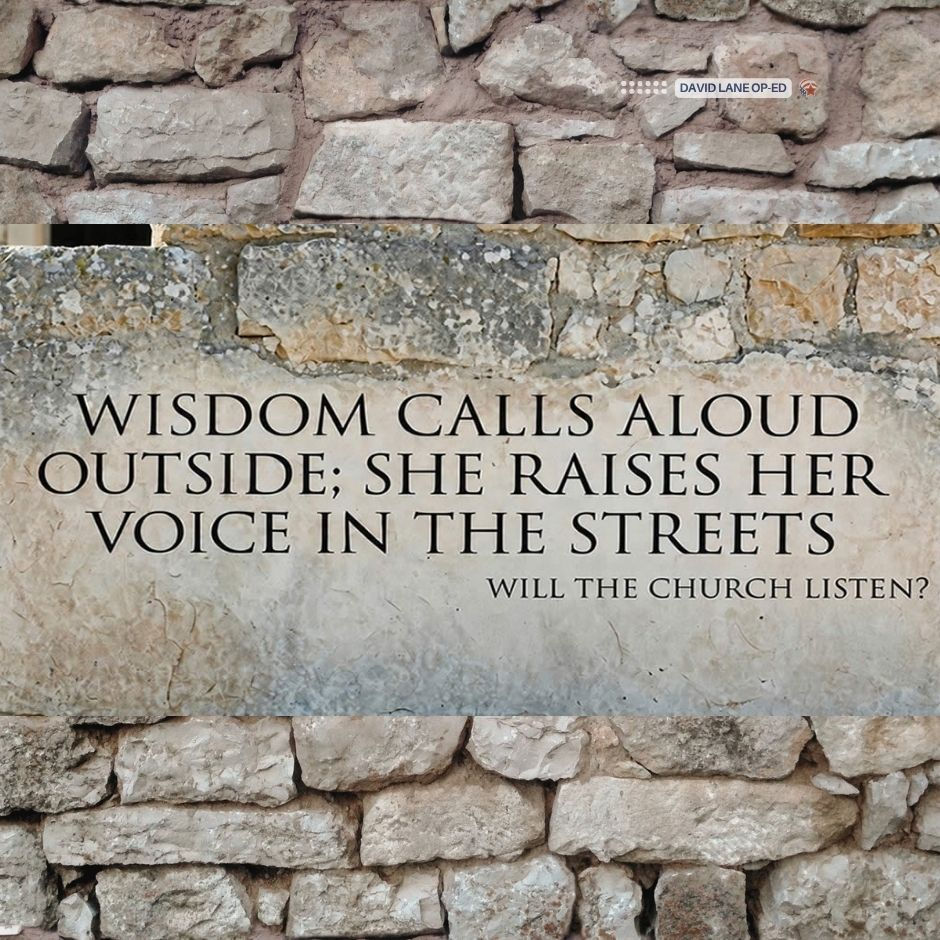
Yet Scripture never presents wisdom as unassertive and diffident. Solomon declares in Proverbs 8 that wisdom cries aloud in the streets. She takes her stand on the heights overlooking the city; her voice is heard at the crossroads, speaking where laws are shaped, where children are formed, and where culture is directed.
Michael V. Fox removes any ambiguity. The path of the wicked is not distant from the path of the righteous. It winds through the very territory of everyday life. One may encounter it not by seeking it, but simply by crossing its path.
When that happens, it is not enough merely to continue walking. One must deliberately turn away; actively shunning evil and veering aside without hesitation. At times, we find ourselves, almost unknowingly, on the brink of wrongdoing and must change course decisively.
“The wicked,” Fox writes, “have a need to cause harm; their ‘peace of mind’ depends upon it. They are not merely lazy, indifferent, or greedy for gain. Their corruption is deep-rooted, their characters warped to the core. Just as wild animals cannot lie down until they have taken prey [Num. 23:24], so the wicked are compelled by nature and habit to do harm.”
Fox’s observation should rouse American Christendom. When shepherds leave the gates unattended, wolves do not remain in the forest, they move into the city. And when wisdom is absent, power fills the vacuum.
The question before the Church is therefore not political but Biblical: Will Christ’s ekklesia return to the gates?
If the Church will not disciple the nation’s children, the state will. If pastors will not form ethics, morality, and character, bureaucrats will. If Biblical truth does not anchor the culture, fleeting emotions will.
What is happening in America is not merely a political moment; it is a theological one.
Thankfully, Gideons and Rahabs have entered the public square.
The ekklesia is rising. |


Comments